multiculturalism

Multiculturalism in Azerbaijan

Azerbaijani people have always paid respect to the traditions and religious views of other nations. For this reason representatives of different religions had lived in peace and friendship in our country. People pursued for their religious views came to our country. In Azerbaijan ancient people worshiped various idols and natural phenomena (Gods of the Sun, the Moon, soil, rain and etc.) and made sacrifices to them. With time fire-worship spread in some parts  of Azerbaijan, especially in the south. This religion was based on the worship of the fire.  
According to fire worship there is a constant struggle between good and evil, truth and lies, light and dark. In this struggle good triumphs over evil, truth over lies, light over dark.  In “Avesta” Lord of Good was called Ahura Mazda, Lord of Evil was called Ahriman. Signs of this religion still remain in some traditions of our nation. 
Since the 1st century Christianity started to spread among the population of Azerbaijan.  At one point Christianity became the official religion of Caucasian Albania, an ancient state in Azerbaijan.  The Albanian temple in the village of Kish in Sheki, one of the first churches in the East, is the cultural relic of that time. 
Islamic religion spread in Arabia by Prophet Muhammad in the 7th century won the favour of our nation. People accepted this religion in a short time. Islam called people to believe only in Allah, to be merciful and fair, to learn science.  Islam was the messenger of unity and goodwill, and promoted the idea of loyalty. After converting to Islam numerous tribes living on the territory of our country became close to one another. The process of national unity in Azerbaijan sped up. Our nation accepted values of Islam and built their life according to them. Islam enriched our national values. A new culture emerged in Azerbaijan due to Islam. Under the influence of Islam Azerbaijani poets, architects, calligraphers created great works of art. 

Multiculturalism in Azerbaijan

Azerbaijani people have always paid respect to the traditions and religious views of other nations. For this reason representatives of different religions had lived in peace and friendship in our country. People pursued for their religious views came to our country. In Azerbaijan ancient people worshiped various idols and natural phenomena (Gods of the Sun, the Moon, soil, rain and etc.) and made sacrifices to them. With time fire-worship spread in some parts  of Azerbaijan, especially in the south. This religion was based on the worship of the fire.  
According to fire worship there is a constant struggle between good and evil, truth and lies, light and dark. In this struggle good triumphs over evil, truth over lies, light over dark.  In “Avesta” Lord of Good was called Ahura Mazda, Lord of Evil was called Ahriman. Signs of this religion still remain in some traditions of our nation. 
 
PHOTO-2022-12-14-11-22-17
Since the 1st century Christianity started to spread among the population of Azerbaijan.  At one point Christianity became the official religion of Caucasian Albania, an ancient state in Azerbaijan.  The Albanian temple in the village of Kish in Sheki, one of the first churches in the East, is the cultural relic of that time. 
Islamic religion spread in Arabia by Prophet Muhammad in the 7th century won the favour of our nation. People accepted this religion in a short time. Islam called people to believe only in Allah, to be merciful and fair, to learn science.  Islam was the messenger of unity and goodwill, and promoted the idea of loyalty. After converting to Islam numerous tribes living on the territory of our country became close to one another. The process of national unity in Azerbaijan sped up. Our nation accepted values of Islam and built their life according to them. Islam enriched our national values. A new culture emerged in Azerbaijan due to Islam. Under the influence of Islam Azerbaijani poets, architects, calligraphers created great works of art. 
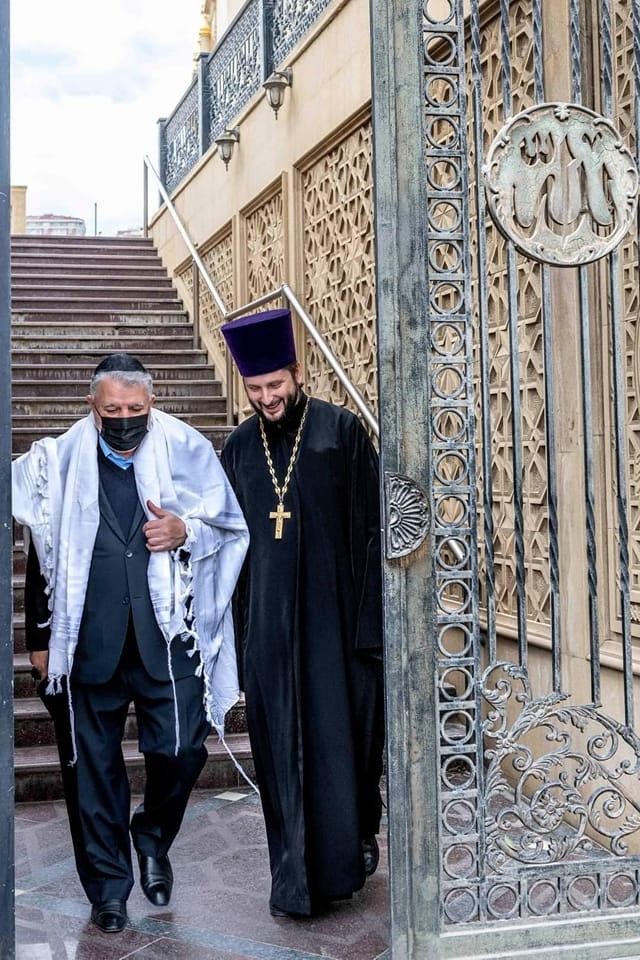
According to the statistics, today about 96 percent of the population of Azerbaijan are Muslims, 4 percent- Christians, Jews, Baha’is, Hare Krishnas and representatives of other religions. About 60-65 percent of Muslims of the country are Shias, while 35-40 percent are Sunnis. In the country, practically there are all currents of Christianity. In Azerbaijan, there live the Christian parishioners of Orthodox, Catholic, Lutheran and Protestant churches, as well as parishioners of historical Albanian church.
At the present time, the State Committee of the Azerbaijan Republic on Work with Religious Associations have registered 941 religious communities.Among them there are 906 Islamic, 24 Christian, 8 Jewish, 2 Baha’i and 1 Krishnareligious communities. (2020)
Today Azerbaijan is distinguished for its ethnographic diversity. Besides Azerbaijani Turks, Mountain Jews, Tats, Talysh, Kurds, Molokans, Ingiloys, Tsakhurs, Avars, Lezgins, Khynalygs, Buduglus, Grysz and other ethnic groups live in its territory. Although the representatives of these ethnic groups consider themselves as Azerbaijanis but each group has retained distinctive elements of their different culture. This culture is reflected in domestic life, crafts, in kitchen and various ceremonies.Let’sget to know some of these ethnic group:

One of the most ancient peoples living in Azerbaijan is the Jews. The Jews presently live in Baku, Sumgayit, Guba, Oguz and Goychay regions. Red settlement in Guba region is the most densely populated area of the Mountain Jews in the world for their number. 

It is a people living in the south-east of the Republic of Azerbaijan, mainly in Lankaran, Astara, Masalli and Lerik regions, as well as in the north of Iran. They speak in the Talysh language belonging to the family of Iranian languages. 

Presently Kurds live in the regional center of Sadarak of Nakhchivan AR, in the Teyvaz village of Julfa region and  Darakand  village of Sharur region. Before the Armenian occupation they lived in  Lachin (Garakechdi, Minkend,  Chiragly villages), in Kalbajar (Aghjakend, Zar villages in full and in other rural villages in mixed environment), in Gubadly (Zilanly village) region. Kurds speak Kurd language belonging to Iranian languages.

The people with small number live in Guba, Khyzy and Khachmaz region of Azerbaijan and in some villages of Baku. According to some researchers, tats are ancestors of ancient Persians resettled here along the western coast of Caspian Sea from Absheron to Derbent, and they are certainlythe most ancient ethnic group of the territory of Shirvan.

Avars is one of ethnic minorities living in Zagatala and Balakan regions of the Republic of Azerbaijan, They speak the Avar language, belonging to the family of the North Caucasus languages. At present, they live in a compact settlements together with Azerbaijanis in Gabagchol settlement of Balakan region, Jar, Zilban, Mazykh, Beretbina, Jinjartala, Katekh, Meshashambul, Mahamalar,  Goyamtala villages. Their religion is Islam.

One of the nomadic peoples of Indo-European origin. Roma can be found in all parts of Eurasia.In Azerbaijan gypsies were resettled in Balakan area during Shah Abbas I to prevent revolts of local tribes. Mainly they live in Shambulbina, Guluzanbina, Melikzada villages. Gipsies of Balakan region speak Farsi. Besides, the Roma live in Shamakhi, Yevlakh regions and Borchali.

It is one of the ethnic groups living in Azerbaijan. Their roots linked with Assyrians lived in ancient Iran and Turkey. At present, they settled as a small ethnic group in Zagatalaregion. 

They are one of aboriginal native nations of Azerbaijan. The ethnicity inhabited in Uti province of the ancient Caucasian Albania, and in several residential villages of Nuharegion (present-day Sheki region) in the nineteenth century. In modern period they live in Nij village of Gabala region and partly in the center of the Oguz region.

As it is seen, multiculturalism is the life style of the Azerbaijani people. After the restoration of the independence government support for the strengthened multicultural traditions has been formed. Policies have been implemented to provide coexistence of these peoples and religions in the condition of friendship. In order to protect and develop all these values, Baku International Multiculturalism Center was established by  the Decree of the President of the Republic of Azerbaijan dated May 15, 2014.